When a Material Starts Writing the Brief
See how an unfamiliar material can shape a design brief, compare three ways to begin, and choose an approach that fits the project’s real constraints.
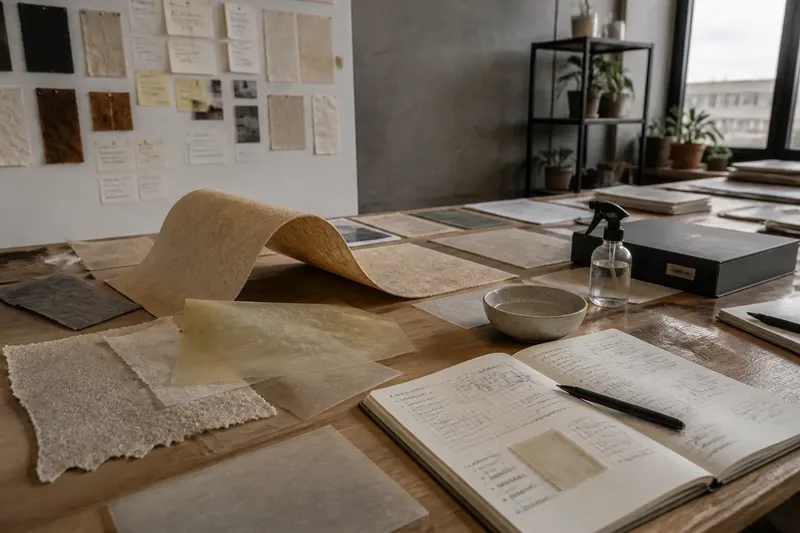
When an unfamiliar material lands on your desk, the first question is not “What should I make?” It is “What can this material reliably do, and what does that make worth designing?” A material-led design brief starts with those properties and limits, then turns them into a problem worth solving. That approach can redirect a project before anyone commits to a finished form.
This does not mean letting novelty dictate the outcome. It means treating the material as a source of evidence: a sheet that bends only along one direction, a fiber composite with irregular edges, or a ceramic surface that changes as it dries. The useful brief connects such observations to a specific need, user, setting, and route to production.
Begin with behavior, not a product category
Product categories can make an unfamiliar material seem more settled than it is. Calling a flexible bio-based sheet “packaging” encourages familiar box shapes before anyone asks whether the sheet folds cleanly, tolerates moisture, or can be separated from its contents. Start by describing behavior instead.
Record what the material does under ordinary handling. Does it crease, stretch, fray, shed dust, hold a curve, or change color when exposed to light? Note whether a property appears consistent across samples. Keep observations distinct from assumptions: “the edge splinters when cut with shears” is more useful than “it is difficult to manufacture.”
Also note the conditions that matter. A material may behave differently when damp, warm, layered, or attached to another surface. For a design brief, the important question is not whether a property is interesting in isolation. It is whether that property can solve a problem in a particular context.
Three ways to let a material shape the brief
There is no single material-led workflow. The right starting point depends on how much is known about the material, how clearly the project’s need is defined, and how much room there is to change the intended product.
Start with a known user need
Begin with a real, bounded problem, then ask whether the new material offers a useful response. A studio designing reusable display labels, for instance, might consider an unfamiliar paper-like sheet because it holds a curve without a rigid backing. The material remains a candidate, not the purpose of the project.
This route suits teams with a clear audience, service setting, or product requirement. It keeps the brief accountable to a need and makes it easier to compare the new material with familiar alternatives. It is less suitable when the material’s behavior is so unfamiliar that the original problem statement would rule out promising uses.
Start with a striking material behavior
Choose a behavior worth investigating, then look for a need it could serve. A sheet that bends in one direction may suggest a curved divider, a protective liner, or a form that packs flat and opens into shape. Each possibility must still be checked against use, handling, and production.
This route suits exploratory work where the application is open and the material offers a distinct capability. Its main risk is building a brief around novelty alone. Keep a simple test for relevance: name the person or process that benefits, the existing difficulty, and the observable change the proposed use should create.
Start with a production constraint
Sometimes the strongest clue is a limit in how the material can be made or converted. An irregular fiber mat may not support fine cutouts, but it might work as a broad panel where its uneven edge becomes acceptable. Here, the constraint narrows the design space and may point toward a different scale, assembly, or product role.
This route suits projects tied to a particular supplier, workshop, waste stream, or fabrication process. It is useful when production conditions are known early. It can be a poor fit if those conditions are still speculative, since the brief may harden around an assumption that later changes.
Choose the approach that matches what you know
Choose by locating the project’s main uncertainty. If the audience and problem are clear but material performance is not, begin with the user need. If the material has an unusual, repeatable behavior but no obvious application, begin with the behavior. If access to the material depends on a specific production route, begin with the constraint.
Say a team receives a translucent, plant-based sheet that softens when damp and has inconsistent thickness. The team already knows that visitors need temporary privacy around a shared changing area. Starting with the user need would focus the brief on privacy, cleaning, and repeated setup, while the sheet’s moisture response could rule it out. Starting with the material behavior might instead prompt exploration of dry, temporary screens for a different setting. Neither choice is automatically right; the useful decision is the one that tests the project’s largest unknown before more specific form decisions follow.
Write down what would change your mind. That might be a material behavior that cannot be repeated, an assembly method that is unavailable, or a user requirement the material cannot meet. A clear stopping condition prevents a material-led project from treating every limitation as an invitation to keep going.
Turn observations into a brief you can act on
A working brief should be specific enough to guide choices without pretending the final form is already known. Include:
- Context: where the design will be used, stored, transported, or handled.
- User or process: who interacts with it, or which task it supports.
- Material behavior: the property the project intends to use, stated as an observation rather than a promise.
- Constraint: the limitation the design must accommodate, such as edge quality, moisture response, or joining options.
- Question to resolve: the most important uncertainty about performance, use, or production.
- Evidence of fit: an observable result that would make the proposed use worth developing.
For example, “Design a new panel from a flexible material” gives little direction. A stronger brief might ask how a bendable sheet could form a temporary screen for a shared work area, while acknowledging that its surface marks easily. It leaves the form open but makes the user, setting, property, and concern legible.
When behavior depends on a label, manufacturer instructions, or local rules, check those before turning an observation into a design requirement.
Keep exploration separate from material claims
An unfamiliar material often arrives with a compelling story: plant-derived, reclaimed, compostable, low-waste, or designed for reuse. Those descriptions do not tell you how it behaves in the intended setting. Ask what the claim means for the finished object, its finishes, coatings, adhesives, and disposal route. A promising origin story cannot substitute for a relevant use case.
For the brief, use plain, verifiable language. “Designed for dry indoor use” is a decision the team can investigate; “sustainable” is too broad to guide a form. If environmental benefit is part of the reason for choosing the material, state what aspect matters and what information is still missing. This keeps the design question focused rather than turning a material’s identity into a verdict.
There is also a difference between a constraint and a defect. An uneven surface might be unsuitable where cleanability matters, yet useful where texture helps distinguish a tactile object. Do not romanticize limitations. Decide whether each one can serve the user’s need, be managed through design, or makes the material a poor fit.
Questions that help settle a material-led brief?
How do I know whether a material property is useful?
Connect the property to a task, person, and setting. If you cannot describe what becomes easier, clearer, safer, or newly possible, keep the property as an observation rather than making it the brief’s central claim.
Should I choose the product before exploring the material?
Choose a product direction early only when the user need or production context is already well defined. Otherwise, leave the form open long enough to see whether the material’s behavior points toward a more suitable application.
What if a constraint rules out the obvious application?
Return to the need rather than forcing the material into a familiar category. The constraint may suggest a different setting, scale, assembly, or user, but it may also show that the material is not a fit for this project.
When should a material-led project stop?
Stop or revise the brief when the material cannot meet a necessary user requirement, when a key behavior is too inconsistent for the intended use, or when the proposed benefit has no clear value in context. A material can be interesting without being the right answer.
Let the brief stay open where the evidence is open
A strong material-led brief is neither a form sketch in disguise nor a catalogue of intriguing properties. It is a focused question that makes clear why this material deserves attention, what its behavior might contribute, and which uncertainty needs resolving before a design direction becomes more specific.
For a project considering an unfamiliar material, write the brief around the most important known need or unknown behavior, not around a fashionable label. That choice gives the material room to shape the work while preserving a practical test for whether the work should continue.