Generative Tools or Hand-Shaped Drafts?
Generative tools or hand-shaped drafts: compare how each shapes early design choices, and choose a starting point that keeps exploration focused.
Should your next design idea begin with a prompt or a pencil? Generative tools or hand-shaped drafts lead to different early choices: one quickly offers unfamiliar options, while the other makes your own assumptions visible through each mark. The useful question is not which method wins, but which kind of uncertainty you need to work through.
What changes when a draft is generated?
A generative tool turns a written or visual input into candidate images, layouts, text, or other material. You can explore several directions without drawing every version yourself. That speed shifts effort from making each first draft to deciding what deserves attention.
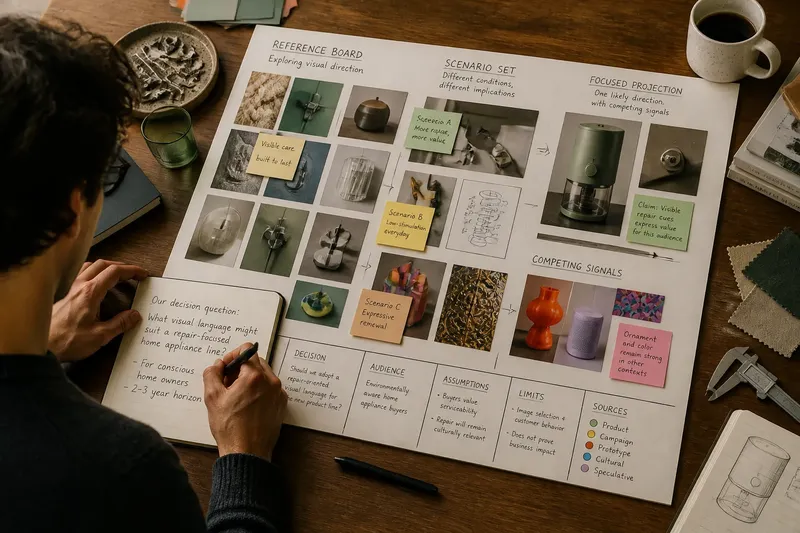
The tool also introduces its own patterns. A prompt asking for a “quiet, welcoming community library” might produce familiar signals such as warm lighting, wood surfaces, and neatly arranged shelves. Those candidates can help reveal a direction, but they may also make a conventional answer feel more settled than it is.
Generated output is therefore most useful as material to inspect, not as a decision made on your behalf. Ask what the image assumes about its audience, setting, and purpose. Then choose whether to keep, alter, combine, or reject those assumptions.
What changes when you shape a draft by hand?
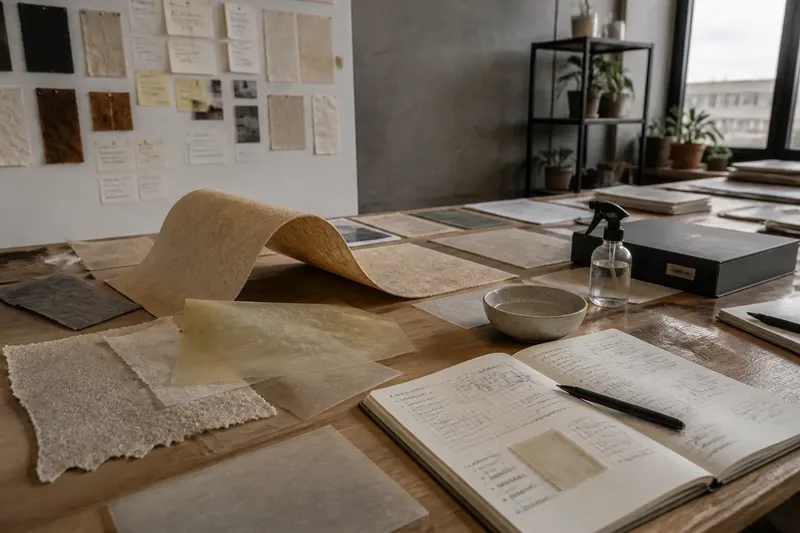
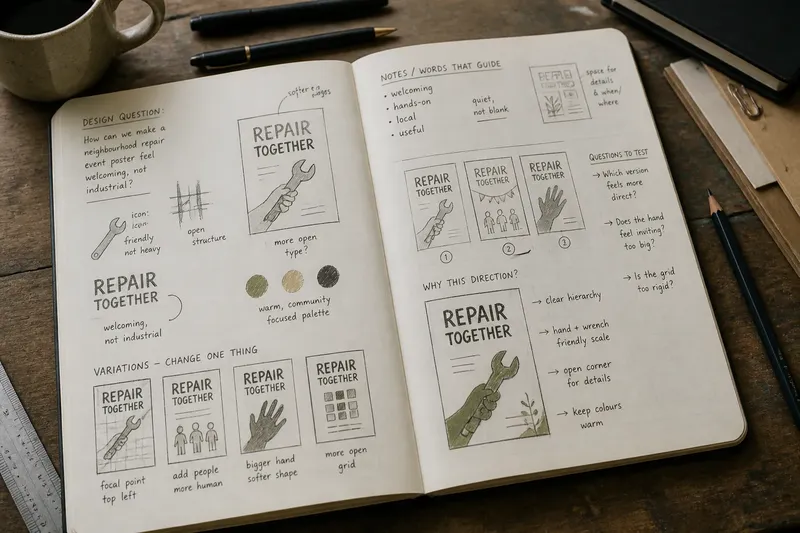
A hand-shaped draft records decisions as you make them. A rough thumbnail, cut-paper arrangement, or quick wireframe forces you to choose where a form begins, what it emphasizes, and which relationships matter. The draft may be incomplete, but its gaps are often informative.
Because each mark takes attention, manual work can narrow exploration earlier. That can be useful when you already have a clear design question, such as how a navigation menu should group tasks. It can be limiting when you need to challenge the visual language you brought into the room.
Handmade does not mean free of convention. Your habits, training, and familiar references shape what you draw, just as a model’s learned patterns shape what it generates. Treat your first sketch as one proposal, not a neutral record of the right answer.
Which approach helps when the brief is still vague?
Generated starts can help you see a broad field of possibilities when the brief leaves room for interpretation. Hand-shaped drafts can help you examine a specific relationship once you know what question to ask. Neither replaces the work of clarifying what the design needs to do.
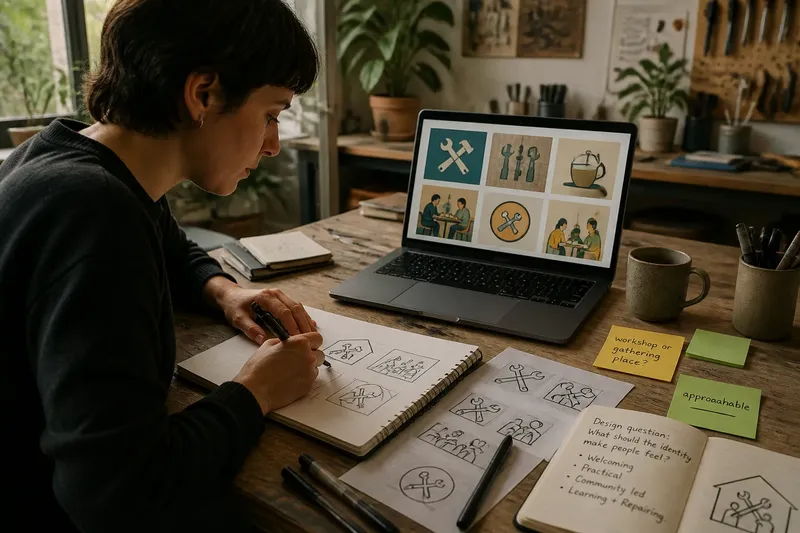
Say you are exploring an identity for a neighborhood repair café, and the brief says only that it should feel approachable. You might prompt an image generator for contrasting visual directions, then notice that its options lean toward tool icons and rustic lettering. Sketching a few alternatives by hand could let you test whether the identity should instead foreground shared learning or the act of repairing. The useful result is a sharper design question, not a pile of polished candidates.
If the brief is vague, write down what you need to learn before making either kind of draft. A short question such as “Should this feel like a workshop or a gathering place?” gives exploration a purpose.
How should you compare generated and hand-shaped drafts?
Compare what each draft helps you notice, rather than judging one by finish and the other by effort. A generated image may look resolved because the software supplies coherent detail. A rough sketch may look less complete while expressing the more relevant idea.
- Range: Do the drafts show genuinely different directions, or small variations on one theme?
- Intent: Can you explain what each option is trying to communicate?
- Specificity: Does it respond to this brief, or could it suit almost any project?
- Editable structure: Can you change the relationships that matter, or only surface details?
- Unnoticed assumptions: What audience, setting, or convention does the draft take for granted?
Use the comparison to choose a next move. If the options differ only in color, change the prompt or redraw the structure. If one direction raises a worthwhile question, make a focused draft that tests it.
What should you check before using generated output?
Check how the tool handles your inputs, what its terms say about generated material, and whether the project requires disclosure or particular permissions. A client brief, workplace policy, or platform rule may set limits that a visual comparison cannot answer.
Also inspect the candidate for details that could mislead an audience or create avoidable problems: invented text, inconsistent interfaces, recognizable branding, or imagery that relies on a stereotype. Remove or replace elements that do not belong. A convincing surface is not evidence that the underlying information is correct.
Keep a simple record of the prompt, the output you selected, and the changes you made when project accountability calls for it. That note makes the design decision easier to explain later.
Can the two methods work together?
Yes. Use each method for the kind of decision it handles well: generation for opening up alternatives, and manual drafting for making relationships deliberate. You do not need to use both on every project, and you do not need to preserve a generated image just because it started the exploration.
One workable sequence is to state a design question, generate or sketch a few contrasting starts, and mark what each reveals. Then make a fresh draft that keeps only the useful decisions. If the first set has pushed you toward an obvious answer, deliberately try a different constraint, such as designing for a narrow screen or removing the expected icon.
Which starting point should you choose?
Choose a generative start when breadth matters and you can judge the outputs critically. Choose a hand-shaped draft when you need control over a specific structure or want to expose your reasoning as it develops. When you are unsure, pick the method that makes the next decision easier to see.
Generative tools or hand-shaped drafts are not competing definitions of design skill. They are different ways to place the first question in front of you: one asks what might appear, the other asks what you choose to make. Keep the draft that leads to a clearer next decision, and let the rest go.