A Close Look at One Emerging Design Idea
Use this emerging design idea review to separate a concept’s stated aim, visible form, and open questions before deciding what it might change.
What does an emerging design idea actually claim, and what can you tell from looking at it? Use this emerging design idea review to keep a compelling image, a bold description, and the evidence in front of you from blending into one impression. A week is enough to give one concept a careful first reading without treating a polished presentation as a finished answer.
Choose one concept you have just encountered: perhaps a public-space proposal, a new interface pattern, a speculative object, or a material-led product. Keep the scope narrow. The aim is not to decide whether the idea is good or predict whether it will spread. It is to distinguish its stated aim, visible form, and unanswered questions so you can describe what is known and what still needs checking.
Start with one concept and a clean record
Save the source where the idea appears, such as a studio page, project deck, exhibition label, or design-journal feature. Record its title, creator or organization, and the context in which it was presented. Keep the original wording and images together; a cropped image can lose a caption that changes what you are seeing.
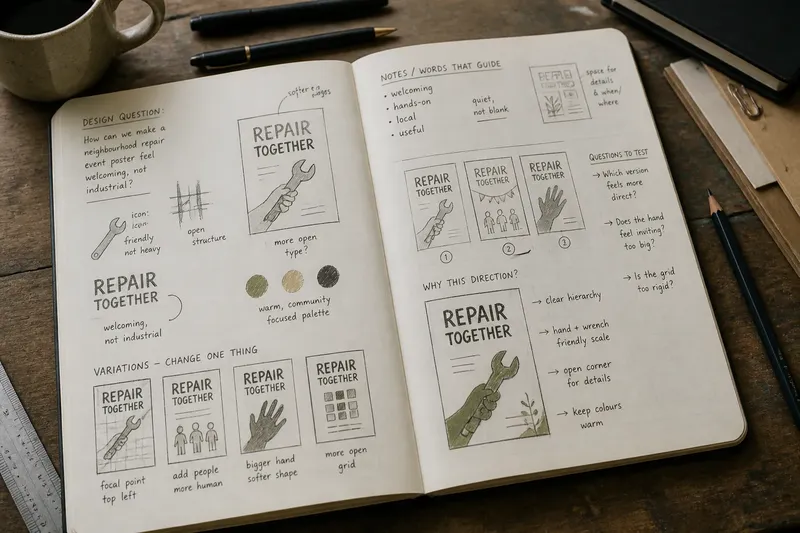
Make a simple note with three headings: Stated aim, Visible form, and Open questions. Leave space under each. Do not fill the page with a verdict such as “successful” or “unrealistic.” Those judgments can wait until you have separated the parts of the concept.
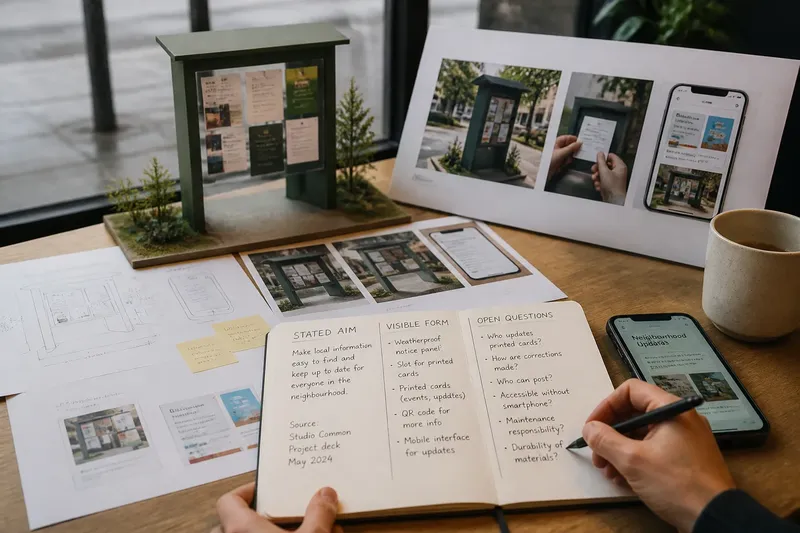
Say you encounter a proposed neighborhood notice board that combines a physical display with a phone-based update. At this stage, note the proposal and its source, not whether residents would use it. The example is invented; its purpose is to show how a small, specific subject gives your review a workable boundary.
On day one, capture the stated aim
Read the project description once without annotating, then read it again and underline the problem the designers say they are addressing. Look for the intended user, setting, and desired change. A claim might be that a service should be easier to find, that an object should invite repair, or that a public space should support more than one activity.
Separate the aim from its supporting language. Words such as “inclusive,” “circular,” or “community-led” can point toward meaningful goals, but they do not explain which decision makes the goal tangible. Ask what a person is meant to do differently and what condition the concept is meant to improve.
Write the aim in one plain sentence, then keep a short quotation or faithful paraphrase from the source beside it. If the source names several aims, list them rather than merging them into a broad promise. A narrow, accurate description is more useful than a generous interpretation.
On day two, inspect the visible form
Study the images, diagrams, interface screens, material samples, or prototypes available. Describe only what is shown. Note the object’s shape, controls, surface, spatial arrangement, sequence of screens, or relation to its surroundings. If the presentation shows a rendering, identify it as a rendering rather than treating it as a photograph of a finished object.
Ask how the form appears to support the stated aim. A handle, label, opening, route, or feedback signal may make an intended action legible. Sometimes the connection is less direct: the visual language may communicate a value without showing how the proposed experience works. Record that gap as a question instead of filling it with an assumption.
For the notice-board proposal, the images might show a weatherproof panel, a row of printed cards, and a phone screen for updates. Those visible elements suggest two ways to encounter information. They do not, by themselves, tell you who posts the cards, how corrections reach the physical display, or whether a passerby can use the board without a phone.
On day three, mark what the presentation leaves open
Read the source a third time with a different task: identify what it does not establish. An open question is not an accusation. It is a boundary around the information available, and it helps keep a concept’s ambition from being mistaken for a demonstrated result.
Sort questions into useful groups:
- Use: Who is expected to interact with it, and in what situation?
- Access: What assumptions does it make about language, ability, equipment, or connectivity?
- Operation: Who maintains, updates, or supports it?
- Material and production: What is specified, and what remains a proposal?
- Evidence: What does the presentation show directly, and what does it only claim?
Choose the questions that would change your understanding of the idea. Avoid collecting every conceivable concern. For the notice board, the route for updating printed information may matter more to the concept’s basic function than a detailed question about the typeface. Keep questions tied to what the idea says it wants to do.
On day four, trace the link between aim and form
Put the aim and visible-form notes next to each other. Draw a line between a stated goal and the feature that appears to serve it. If there is no clear feature, write “not shown” or “unclear.” This small notation prevents a persuasive description from silently supplying a missing design decision.
For every link, ask what the source lets you observe. A screen may show a confirmation message, while a written description may claim that it reduces confusion. You can record the message as visible and the claimed effect as a claim. Do not turn the second into a fact merely because it sounds plausible.
Now identify the kind of material you are reviewing: an idea sketch, a visual proposal, a prototype, a documented use, or a finished offering. These forms carry different amounts of information. A speculative image can make a direction understandable, but it may leave everyday handling, maintenance, and constraints unresolved.
On day five, look for context without borrowing certainty
Check whether the concept is presented in relation to a particular place, audience, material practice, or tool. Notice whose needs are named and whose experience is absent from the description. Look for a stated setting rather than assuming that an object or visual system will behave the same way in every context.
When the source links to supporting material, inspect it only for the questions your notes have raised. A process image may clarify whether a form is a model or a working prototype. A material note may identify a surface but not explain how it is maintained. Keep each new detail attached to its source, and distinguish an explanation from an independent account of use.
For the invented notice board, a project page might specify that the proposal is intended for a library entrance. That setting narrows the question of where it appears, but it does not answer who updates the cards or how visitors who do not use smartphones receive current information. Context makes questions sharper; it does not automatically resolve them.
On day six, compare interpretations before settling on yours
Write two short readings of the concept. In the first, describe it as the designer presents it. In the second, describe what a viewer can verify from the materials you have seen. Keep both readings fair. The difference between them is often where the most useful editorial question lies.
Imagine you are reviewing the invented notice board for a design discussion. The designer’s account might frame it as a way to connect printed neighborhood information with digital updates. Your viewable evidence might be a rendering of the board and a phone-screen mock-up. Your open question could be how an update moves from one format to the other. That formulation is precise without dismissing the idea or claiming that its process has been demonstrated.
Then ask one colleague to read your notes without seeing your judgment. If they cannot tell which points came from the source and which are your questions, revise the labels. This is a quick way to catch an interpretation that has slipped into the record as though it were visible evidence.
On day seven, write a measured account
Draft a short account in this order: the concept’s stated aim, the form or interaction shown, the connection between them, and the most important unanswered question. Use verbs that match what you know: “describes,” “shows,” “proposes,” or “does not specify.” Avoid language that upgrades an intention into an outcome.
Before sharing, check the account against your source. Confirm that you have not attributed a feature to the concept that appears only in your own imagined use. Make clear when an image is a rendering, when a behavior is described but not shown, and when your question comes from missing information. If you cannot tell what kind of material you are looking at, say so plainly.
Your final note can be brief, but it should leave a reader with a clear distinction: what the designers want to change, what the design visibly offers, and what remains unknown. That distinction makes an emerging design idea easier to discuss without forcing an early yes-or-no verdict.
Which questions make the review more useful?
How do I tell a design aim from a visual style?
An aim describes a change the concept intends to support; a style describes qualities such as color, shape, texture, or typography. A visual choice may help communicate or enable an aim, but record the connection only when the source or the visible design makes it clear.
What can I say about a rendering?
Describe what the image depicts and identify it as a rendering, proposal, or other stated format. Do not use it as evidence that the depicted object has been built, used, or maintained in the setting shown.
What should I do when the source makes broad claims?
Preserve the claim in accurate language, then ask what observable feature or supporting information would clarify it. If that information is absent, mark the claim as unestablished in the material you reviewed rather than treating it as either true or false.
How much time should I spend reviewing one concept?
Match the effort to the decision you need to make. A week-long routine suits a considered editorial or studio discussion; a quick first impression can use the same three headings without pretending to resolve questions the source does not answer.
Keep the record open to revision
File the notes with the source and date of your review, then add new information only when it addresses a named question. A later prototype, clearer material description, or account from an intended user may change your reading. Keep the original note intact and mark what new information changed, so the concept’s development stays distinct from your first impression.
The most useful emerging design idea review does not force certainty. It gives you a disciplined way to say what the concept seeks, what its form makes visible, and which question deserves attention next.